
- STRICH SPS-60 lists 10 DC outputs: seven 9V 300mA, one 9V 500mA and two switchable 500mA ports, plus 5V 1A USB.
- Donner DP-Z lists 10 DC outputs from 9V 100mA up to 18V 300mA, a 5V 1000mA USB port and an 18V 2000mA input.
- On paper the SPS-60 lists more total current; the DP-Z lists four low-current 100mA ports and LED strips.
- Whichever you pick, match each pedal's voltage, polarity and current to the listed ports.
- Other brands worth a look: Voodoo Lab, LEKATO, Fender and D'Addario.
STRICH vs Donner comes up when a pedalboard needs one box that runs every pedal from a single outlet. Both brands sell supplies with ten DC outputs, per-port short-circuit protection and a USB port, but their listings divide the current differently.
We compare the STRICH SPS-60 with the Donner DP-Z, add the STRICH SPS-30 MAX for its 18V 1000mA port, and then look at other brands. Choosing a board to match? See pedalboards and pedal cases, or browse all pedal power supplies.
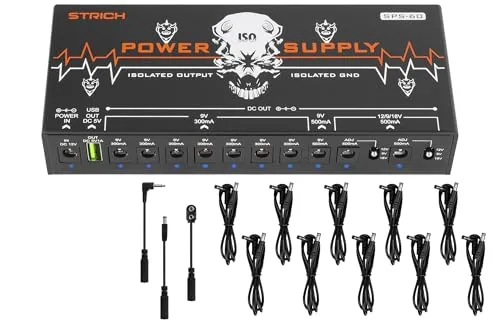
STRICH SPS-60 10-Output Pedal Power Supply for 9V/12V/18V Guitar Pedal
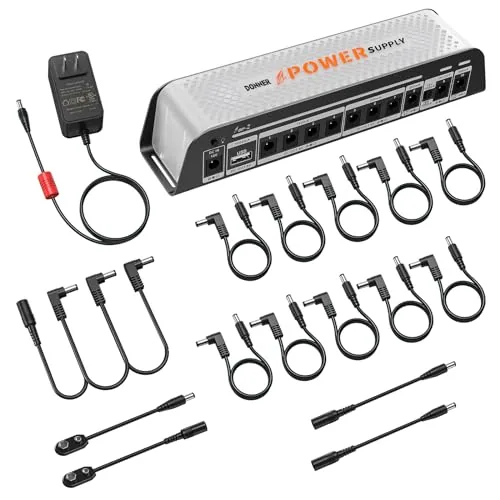
Donner DP-Z 9V Guitar Pedal Power Supply
STRICH vs Donner: the listed specs
| Spec | STRICH SPS-60 | Donner DP-Z | STRICH SPS-30 MAX |
|---|---|---|---|
| DC outputs | 10 | 10 (title says 11 with USB) | 8 |
| 9V ports | 7 x 300mA, 1 x 500mA | 4 x 100mA, 3 x 300mA, 1 x 500mA | 5 x 200mA |
| Switchable ports | 2 x 500mA, 9V/12V/18V | 1 x 500mA 9V/12V, 1 x 18V 300mA | 9V/12V 300mA, 12V/18V 300mA, 18V 1000mA |
| USB | 5V 1A | 5V 1000mA | Not stated |
| Short-circuit protection | Independent per output | Independent per output | Independent per output |
| Adapter input | Not stated | DC 18V 2000mA | Not stated |
| Extras listed | Isolated grounding wording | Blue, orange and red LED strips | 18V 1000mA port |
| Warranty | One year | 1 year | 1 year |
Total listed DC current per supply
Sum of listed DC ports, USB excluded
What does an isolated pedal power supply do?
A daisy chain feeds several pedals from one adapter and one shared ground, so noise or a fault in one pedal can reach the others. A multi-output supply gives each pedal its own port with its own protection, which is why the listings stress independent short-circuit protection: when one cable shorts, the other ports are listed as still working.
Isolation is described in different ways. Some supplies use separate transformer windings, others use regulators and circuit design, and brands word this differently. That is why this comparison quotes each listing instead of ranking the claims.
Current ratings work in one direction. A pedal draws only what it needs, so a port rated above the pedal's label is the normal match, while a port rated below it is not. Voltage and polarity must always match the label.
Where does STRICH fit better?
The SPS-60 lists seven 9V 300mA ports, one 9V 500mA port and two ports that switch between 9V, 12V and 18V at 500mA. That layout suits a board with several digital pedals, because no port is listed below 300mA. The listing describes channel-separated regulation and internally isolated grounding, and a 5V 1A USB output.
The SPS-30 MAX trades port count for an 18V 1000mA port and five 9V 200mA ports, which the listing aims at power-hungry pedals. Read isolation wording closely: STRICH's SPS-40B listing says its design does not represent complete absolute electrical isolation. The SPS-60 and SPS-30 MAX listings do not state what comes in the box, so check the product page for the adapter and cables.
Where does Donner fit better?
The DP-Z lists four 9V 100mA ports, three 9V 300mA ports, one 9V 500mA port, one 9V/12V 500mA port and one 18V 300mA port. If most of your pedals are small analog drives, the 100mA ports are the match, and the listing names an 18V 2000mA adapter as the input.
It also lists a 5V 1000mA USB port and three LED strips, one blue, one orange and one red, which light the board and flag a short. The listing's title counts 11 outputs while the bullets list 10 plus USB, so read the bullets.
How many outputs and how much current do you need?
Count pedals first, then read each label. A typical small board might hold a tuner, two drives, a modulation pedal, a delay and a reverb: six ports, with the digital delay and reverb needing the higher-current ports. A board that size sits comfortably on a ten-output supply with room for a spare.
Total current is a weak guide. Ten 100mA ports and ten 500mA ports are very different supplies even if the box sizes match. Look at the highest-current port you need, the voltage options and whether a spare port is left. For the board itself, see pedalboards and pedal cases.
Which should you buy for your pedals?
- Several digital pedals or a looper: STRICH SPS-60, for its 300mA and 500mA ports.
- One hungry 18V pedal: STRICH SPS-30 MAX, which lists an 18V 1000mA port.
- Mostly small analog pedals: Donner DP-Z, with four 100mA ports and a stated adapter.
- Twelve equal 500mA ports: Voodoo Lab or Fender, below.
- Amp or speaker on the board: a supply with AC outlets such as Hiree's, which lists 600W in total.
Whatever you choose, a supply lists what it outputs, not what your pedals accept. Check each pedal's label for voltage, polarity and current before connecting. More choices sit in pedal power supplies.
How we compared
We read each listing for output count, voltage, current per port, USB, adapter input, protection, warranty and extras. Totals in the chart are plain sums of listed ports, and anything a listing does not say is marked "not stated" instead of filled in.
Checklist before you choose
- Write down each pedal's voltage and current from its label.
- Count pedals, then add one spare port.
- Match each pedal to a port at or above its current and at the same voltage.
- Check polarity. Most guitar pedals use center-negative; a few differ.
- Check the box contents on the product page: adapter, cables, reversers.
- Pick a board to fit the supply; see pedalboards and pedal cases.
Mistakes to avoid
- Reading "isolated" as the same thing in every listing. Wording differs by brand and product.
- Plugging a 12V or 18V pedal into a 9V port.
- Powering a digital pedal from a 100mA port because it fits the jack.
- Skipping the box check. The STRICH listings here do not say what is included.
For single-brand detail, read best pedal power supply and SPS-10 vs SPS-20. The best guitar pedalboard guide covers decks to mount a supply on.
Other brands worth a look
Voodoo Lab's Pedal Power 3 PLUS lists 12 isolated 500mA outputs, ten at 9V and two switchable 9V/12V, with X-LINK expansion ports, 100-240VAC input and a 5-year warranty for North America. Fender's Engine Room LVL12 lists 12 ground-isolated outputs, ten fixed 9V 500mA and two switchable, plus USB-A and USB-C charging. LEKATO's 10-port supply lists seven 9V 300mA, one 9V 500mA and two adjustable 500mA ports. D'Addario's PW-CT-9V is a single 9V 800mA tip-negative adapter, which suits a board with one or two pedals. D'Addario's XPND kit lists a rechargeable 10,000mAh battery and a USB-C power supply, which suits players without a mains outlet near the board. Hiree's seven-output supply adds two AC outlets with a 600W total listed.
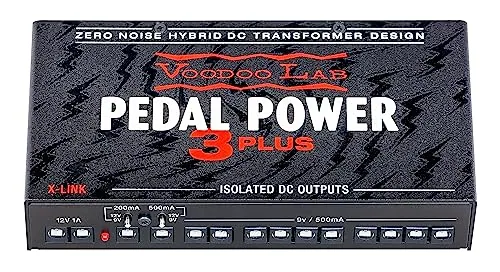
Voodoo Lab Pedal Power 3 PLUS High Current 12-Output Isolated Power Supply
Check price →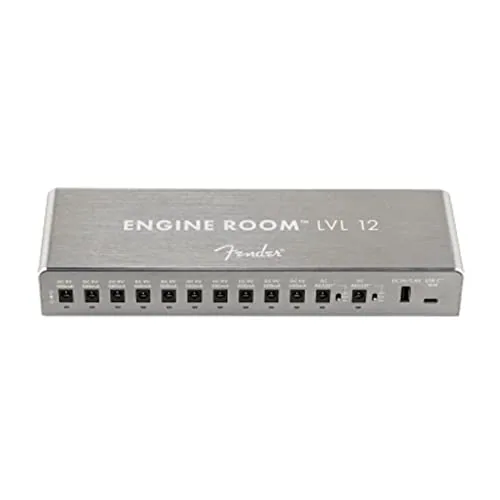
Fender Engine Room LVL12 Power Supply
Check price →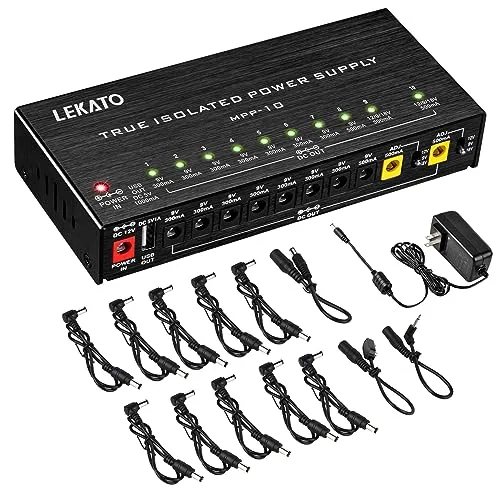
LEKATO Guitar Pedal Power Supply
Check price →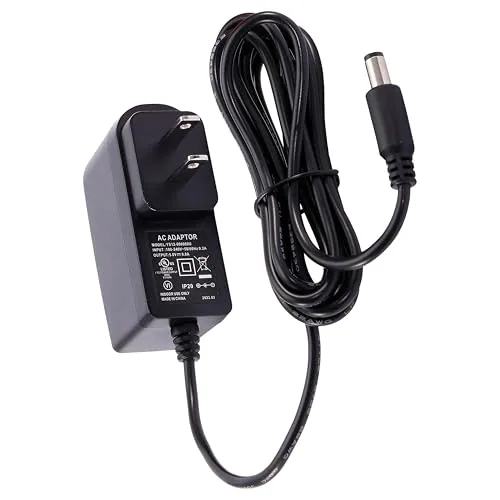
D'Addario Accessories PW-CT-9V DC Power Adapter
Check price →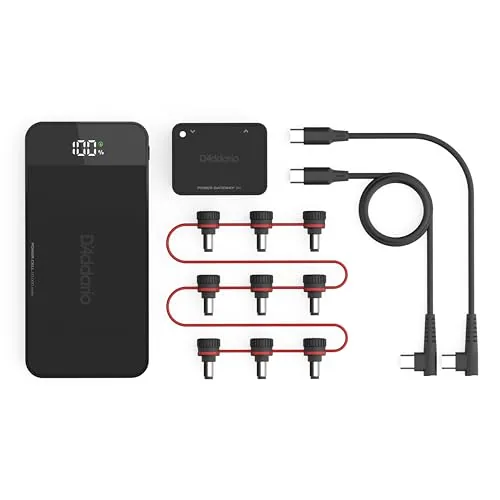
D'Addario Accessories XPND Pedal Power Battery Kit - Guitar Pedal Power Supply
Check price →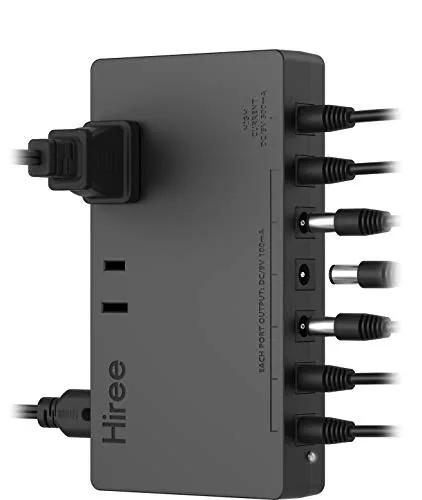
Hiree Guitar Pedal Power Supply 7 DC Output for 9V Effect Pedal Board with 2 A
Check price →FAQ
STRICH vs Donner: which pedal power supply lists more current?
Summing the listed DC ports, the STRICH SPS-60 totals 3600mA and the Donner DP-Z 2600mA. What matters is whether each pedal gets a port that meets its own draw.
Does the Donner DP-Z have a USB port?
Yes. The listing gives a 5V USB charge port at 1000mA, in addition to the DC outputs.
Can I run 12V and 18V pedals from these supplies?
Both list ports for them. The DP-Z lists one 9V/12V 500mA port and one 18V 300mA port; the SPS-60 lists two ports switchable between 9V, 12V and 18V at 500mA. Check your pedal first.
Are the outputs fully isolated?
Both listings use isolation wording. STRICH's SPS-40B listing notes its design is not complete absolute electrical isolation, so read each listing and the pedal's needs carefully.
Does the STRICH SPS-60 include an adapter?
The listing text does not say. Check the product page for the box contents before ordering.
What should I check before connecting any pedal?
Voltage, polarity and current on the pedal's label, then the matching port and cable on the supply.