
- Same DC side: six 9V 100mA, two 9V 500mA, one 12V 100mA and one 18V 100mA on both.
- Both list independent short-circuit protection per port and a blue LED fault indicator.
- The SPS-20 adds four AC socket holes on top, rated up to 600W.
- The SPS-10 listing spells out the box: 18V/1A adapter, ten DC cables, two reversal cables.
- Pedals only? SPS-10. Amp and tuner on the board too? SPS-20.
The SPS-10 vs SPS-20 question is simpler than it looks: STRICH gives both supplies the same ten DC outputs, so the choice comes down to one feature on top of the housing. That feature is a row of mains sockets.
Below we put the two listings side by side, explain what the shared output layout can and cannot power, and suggest which board each one suits.
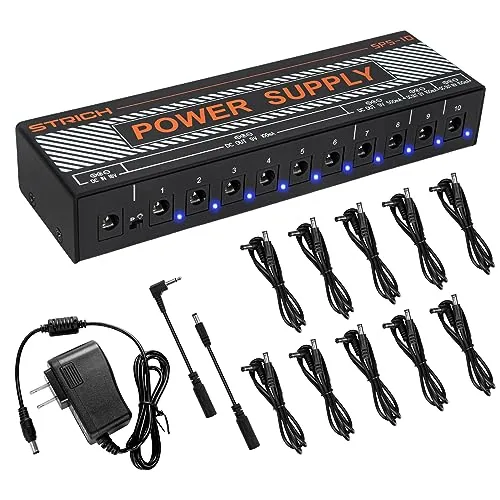
STRICH SPS-10 Guitar Power Supply 10 Independent DC Output
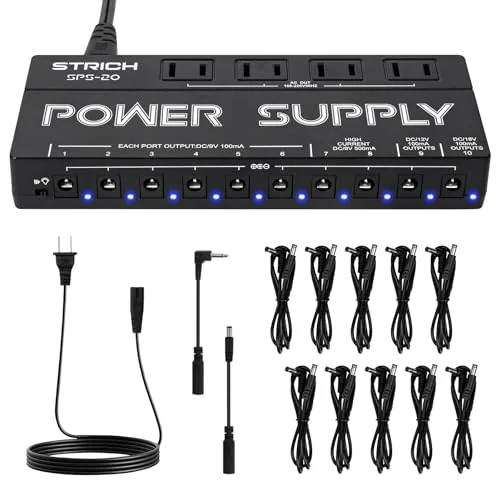
STRICH SPS-20 10-Output Pedal Power Supply for 9V/12V/18V Guitar Pedal
SPS-10 vs SPS-20 specs side by side
| Spec | SPS-10 | SPS-20 |
|---|---|---|
| DC outputs | 10 | 10 |
| 9V outputs | 6 x 100mA, 2 x 500mA | 6 x 100mA, 2 x 500mA |
| 12V output | 1 x 100mA | 1 x 100mA |
| 18V output | 1 x 100mA | 1 x 100mA |
| AC sockets on top | ✗ | ✓ 4, up to 600W |
| Per-port short protection | ✓ | ✓ |
| Noise filter | ✓ | ✓ |
| Housing | Aluminum alloy | Aluminum alloy |
| Blue LED indicator | ✓ | ✓ |
| Box contents listed | ✓ Adapter, 10 DC cables, 2 reversers | ~ Not detailed |
| Warranty | One year | One year |
Shared DC output layout
Identical on SPS-10 and SPS-20, count of ports
Six of ten ports are 9V at 100mA, which covers most analog drives, fuzzes and modulation pedals. The two 500mA ports are for digital delays, reverbs and loopers.
What the SPS-20's AC sockets are for
The listing describes four double-ended socket holes on the top face that output the same voltage as the wall. In practice, that turns the supply into a small power strip that lives on your pedalboard.
- Plug a small amp or powered speaker into the board.
- Run a tuner, wireless receiver charger or lamp from the same cable.
- Bring one extension lead to the stage instead of two or three.
If you never plug anything but pedals into your board, those sockets add bulk without a payoff. That is where the SPS-10 makes more sense.
One more practical point: AC sockets on the board mean mains voltage runs through your rig. Keep drinks away, route the main cable so nobody trips on it, and switch everything off before swapping pedals.
How to choose between them
- List every pedal and its draw. If more than two need over 100mA at 9V, neither supply covers it alone; consider the STANDARD 15's 300mA and 700mA ports.
- Check 12V and 18V needs. Both supplies give one of each at 100mA. Higher-draw 12V pedals need another source.
- Decide on AC. Want mains on the board? SPS-20. Otherwise SPS-10.
- Check polarity. The SPS-10 includes two reversal cables for center-positive pedals.
Most players can answer these four questions in five minutes with their pedals in front of them. Write the voltage and current of each pedal on a strip of tape, line them up, and match them to ports on paper before you order. It is the fastest way to spot a pedal that needs more than 100mA or an unusual polarity.
Our best pedal power supply guide ranks these against the powered STANDARD 15 board, and every model is listed in the home page comparison.
Can either supply handle digital pedals?
Yes, within limits. Both units offer two 9V outputs at 500mA, which is the right home for a digital delay, reverb, multi-effect or the STRICH Circle Loop looper. The remaining six 9V ports at 100mA suit analog drives, fuzzes, boosts, choruses and most tuners.
The tight spot is a board with three or more power-hungry pedals. With only two high-current ports, the third digital pedal has nowhere to go. In that case, the STANDARD 15 board offers one 300mA and one 700mA 9V port, or you can pair an SPS unit with a dedicated adapter for the extra pedal.
Example rig on either SPS
- Two digital pedals (delay and reverb) on the 9V 500mA ports.
- Tuner, compressor, two drives, chorus and a boost on the six 9V 100mA ports.
- A low-draw 12V or 18V pedal on the matching outputs.
Ten pedals on ten ports, each with its own protection. If a cable shorts mid-song, the blue LED flags the fault and the other nine pedals keep running, per the listings.
Which board for each supply?
Neither supply is needed on the STANDARD 15, which has power built in. The STANDARD 18 at 1.98 lb pairs naturally with the SPS-10 for a light mid-size rig. The STANDARD 22 has the space for the SPS-20 and a fuller rig, so the amp and tuner share the AC sockets while pedals take the DC side. Sizing tips are in our pedalboard guide.
STRICH SPS-10 Guitar Power Supply 10 Independent DC Output
Check price →STRICH SPS-20 10-Output Pedal Power Supply for 9V/12V/18V Guitar Pedal
Check price →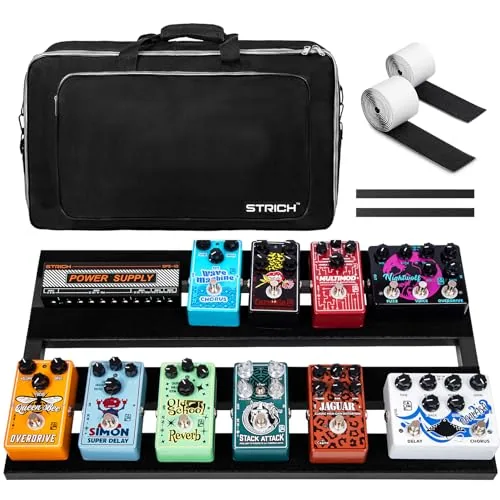
STRICH Guitar Pedal Board Aluminum Alloy 2.65lb Lightweight Effect Pedalboard
Check price →Also worth knowing: STRICH describes the outputs as isolated through individual positive supply control. As our about page notes, that is a circuit-design approach rather than full transformer isolation.
On paper, the SPS-10 and SPS-20 are the same pedal supply with one difference: four AC sockets. The SPS-10 is the better buy for most pedalboards, especially since its listing confirms the cables and reversers in the box. The SPS-20 earns its place on a large board like the STANDARD 22 where the amp and accessories should plug in at the pedals.
FAQ
What is the main difference in SPS-10 vs SPS-20?
The SPS-20 adds four AC socket holes on top that pass wall voltage at up to 600W. The DC outputs are identical.
Can the SPS-10 power a looper?
Yes, from one of its 9V 500mA ports. The STRICH Circle Loop needs 9V at 300mA minimum, center-negative.
Do both supplies work on 110V and 220V?
The SPS-10 listing states AC 100V-240V input. The SPS-20 listing does not spell out the input range, so check the adapter label.
Are the SPS outputs isolated?
Each port has its own positive supply control and short-circuit protection, which STRICH calls isolated outputs with noise reduction.
Can I chain two pedals from one output?
You can on a high-current port if the combined draw stays under its rating, but a separate port per pedal keeps noise and faults contained.
What warranty do they have?
Both list a one-year warranty.