
- A stereo looper and a drum machine in one pedal, usable together or separately.
- 40 loop slots of up to four minutes each, for 160 minutes in total.
- 100 drum patterns across ten styles, with 24-bit/44.1kHz audio.
- No battery and no adapter in the box: use 9V DC, 300mA minimum, center-negative.
- Best for solo practice, songwriting and busking.
The STRICH Circle Loop is a two-in-one pedal: a stereo looper and a drum machine that run independently or together. For solo players, that means a backing rhythm and layered parts from one footprint on the board.
This review reads the listing closely: what the looper stores, what the drums cover, how to power it safely, and where it fits in a STRICH rig. It is a spec-based look, not a lab test.
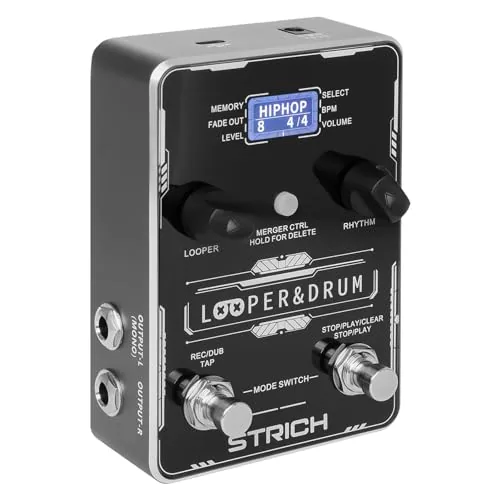
STRICH Circle Loop 2-in-1 Drum Machine & Stereo Looper Pedal for Guitar
On paper, the STRICH Circle Loop packs a lot into one housing: four-minute loops in 40 slots and 100 drum patterns that sync with them. It suits practice and solo gigs better than a dedicated looper plus a separate drum box. Budget for a proper 9V adapter, since none is included.
- Practicing timing over a drum pattern
- Layering chords, bass lines and leads when writing
- Buskers and solo acts who want rhythm without a laptop
- Players who need battery power
- Loopers longer than four minutes per slot
- Anyone who already runs a drum machine they like
What does the STRICH Circle Loop do?
The listing describes a merger control that lets the looper and drum machine work independently or in combination. Start a drum beat, record a chord loop over it, then solo on top.
The looper
- 40 presets, each holding up to four minutes
- 160 minutes of total recording capacity
- 24-bit/44.1kHz DSP for clean playback, per the maker
- Stereo operation, with a mic track mentioned alongside instrument tracks
- A bright screen showing loop mode, progress and timing
The drum machine
Ten drum styles with ten patterns each give 100 patterns. The listing names pop and rock among the styles. For practice, the drum side alone works as a more musical metronome.
Circle Loop by the numbers
From the STRICH listing
Circle Loop specs and power
| Spec | Circle Loop | What it means |
|---|---|---|
| Functions | Looper + drum machine | Two pedals in one footprint |
| Loop slots | 40 | Save song ideas between sessions |
| Max loop length | 4 minutes | Enough for a full verse-chorus cycle |
| Total storage | 160 minutes | Every slot can be full |
| Drum patterns | 100 (10 styles x 10) | Practice in many genres |
| Audio | 24-bit/44.1kHz | CD-quality sample rate |
| Power | 9V DC, 300mA min, center-negative | ✗ Adapter not included |
| Battery | ✗ None | Must run on a supply |
| Warranty | One year | Per the listing |
On an SPS-10 or SPS-20, use one of the two 9V 500mA outputs. On the STANDARD 15 board, the 300mA or 700mA output works. Our pedal power supply guide explains each port.
A quick sanity check before your first session: confirm the adapter barrel matches, the polarity symbol shows center-negative, and the rating reads 300mA or higher. A spare 500mA adapter in the gig bag is cheap insurance if you play away from your own board.
Where the Circle Loop fits on a board
Loopers usually sit last in the chain, after drives, modulation, delay and reverb, so the loop captures your full tone. Place it at the front edge of an angled board so the footswitch is easy to reach. Our home page suggests it for a practice room without a drummer; its specs sit in the full comparison.
STRICH Circle Loop 2-in-1 Drum Machine & Stereo Looper Pedal for Guitar
Check price →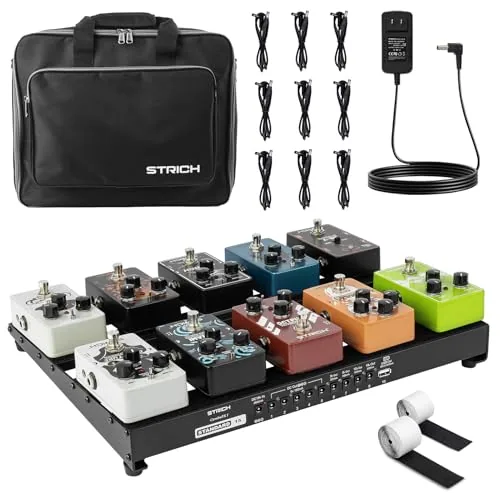
STRICH Pedal Board with Built-in Power Supply
Check price →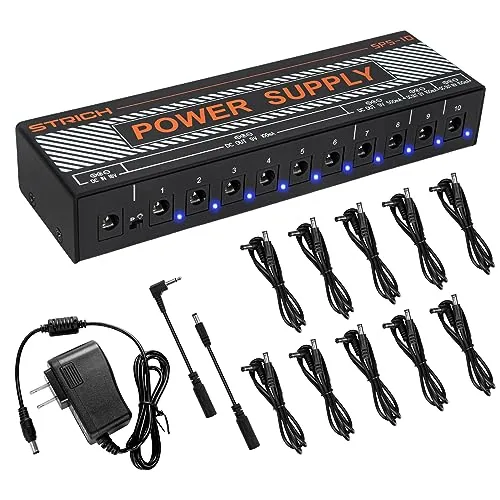
STRICH SPS-10 Guitar Power Supply 10 Independent DC Output
Check price →Building a first board around it? The pedalboard guide compares sizes, and the STANDARD 15 review covers the powered board that already has a suitable output.
Is a two-in-one looper better than separate pedals?
A separate looper and drum machine give you two sets of controls, two power cables and two spots on the board. The Circle Loop folds both into one housing, which saves space on a small board like the STANDARD 15.
Where the combined design helps
- Fewer patch cables and one power connection.
- Drums and loops start together, so timing stays locked.
- One screen shows loop mode, progress and timing at a glance.
Where separate units still win
- If you want to place drums and looper in different spots in the chain.
- If you need battery power, which this pedal does not offer.
- If you already own a drum machine you prefer.
For most bedroom players and solo performers, the combined pedal is the simpler setup. The 100 patterns cover practice in many styles, and 40 slots are plenty for storing song sketches.
How to get the most from a looper and drum pedal
- Start with drums only. Pick a pattern and tempo before recording so loops land in time.
- Record short first. A tight four-bar loop is easier to layer than a long one.
- Use slots as a notebook. 40 slots let you keep riffs from different sessions.
- Balance levels. Keep the drum level below your guitar so the loop sits in the mix.
- Practice the stop. Ending a loop cleanly is the hardest live skill.
Stereo outputs are worth using if you have two amps or a stereo interface. Panned drums and layered loops sound wider, and the effect is noticeable even at bedroom volume. If you run mono, a single output still carries the full mix.
For a home practice corner, a floor rack keeps the guitar within reach between takes. Our multi-guitar stand guide has options, and the Circle Loop also appears in our gift guide.
The Circle Loop makes the most sense for players who practice alone, write songs or busk. Forty slots, four-minute loops and 100 drum patterns cover far more than most beginners will use. The main catch is power: there is no battery or adapter, so plan a 9V, 300mA center-negative source before it arrives.
FAQ
Does the STRICH Circle Loop come with a power supply?
No. The listing says to use a 9V DC adapter rated at least 300mA, center-negative, and notes there is no battery compartment.
How long can each loop be?
Up to four minutes per preset, across 40 presets, for 160 minutes in total.
Can I use the drum machine without looping?
Yes. The merger control lets the drum machine and looper run independently or together.
How many drum patterns does it have?
100, made of ten styles with ten patterns each.
Is the Circle Loop stereo?
Yes, STRICH describes it as a stereo looper. You can still run it in mono into a single amp.
Can I power it from a STRICH SPS supply?
Yes, from one of the 9V 500mA outputs on the SPS-10 or SPS-20.