
- A 15 x 11 inch aluminum pedalboard with the power supply built into the frame.
- Seven 9V outputs (five 100mA, one 300mA, one 700mA), one 12V 500mA and one 18V 500mA.
- A USB 5V/800mA port charges a phone; a DC18V 2000mA adapter feeds it all.
- Weighs 2.17 lb and ships with pedal cables, a bag and hook-and-loop strips.
- Ideal for four to six pedals; bigger rigs should look at the STANDARD 18 or 22.
The STRICH STANDARD 15 is a compact aluminum pedalboard with its power supply built into the frame. Instead of a board plus a supply plus a bag of cables, you get one piece that is ready to wire.
This review covers what the listing says about its outputs, size and included parts, how it compares with the larger STRICH boards, and the kind of rig it suits best.
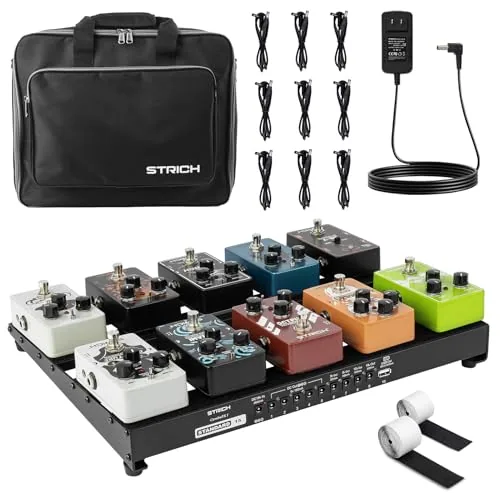
STRICH Pedal Board with Built-in Power Supply
On paper, the STANDARD 15 is the tidiest way to build a small board: power, cables and a bag in one box at just over two pounds. Its 300mA and 700mA 9V ports and 500mA 12V and 18V ports handle digital pedals better than many add-on supplies. The limit is space, so plan on four to six pedals.
- Fly rigs and weekend gigs
- Players moving off a daisy chain
- Rigs that include one or two current-hungry digital pedals
- Boards with more than six pedals
- Players who want to reuse the supply on a future board
- Anyone needing AC sockets on the board, which only the SPS-20 offers
STRICH STANDARD 15 power outputs explained
The listing counts ten independent ports, each with its own short-circuit protection. Here is how they break down.
Current per output
STANDARD 15 built-in supply, from the listing
Five 100mA ports cover analog drives, fuzz and modulation. The 300mA port suits a typical digital delay or the STRICH Circle Loop, which needs 300mA minimum. The 700mA port can take a hungry reverb or small multi-effect.
The 12V and 18V outputs are rated at 500mA, five times what the SPS-10 and SPS-20 list for those voltages. That is a real advantage for 12V preamps and some modern pedals.
How the STANDARD 15 compares with the 18 and 22
| Spec | STANDARD 15 | STANDARD 18 | STANDARD 22 |
|---|---|---|---|
| Size | 15 x 11 in | 18 x 12.5 x 3.15 in | 22 x 12.5 x 3.15 in |
| Weight | 2.17 lb | 1.98 lb | 2.65 lb |
| Built-in power | ✓ 9 DC + USB | ✗ | ✗ |
| 12V and 18V current | 500mA each | ~ Depends on supply | ~ Depends on supply |
| USB charging | ✓ 5V 800mA | ✗ | ✗ |
| Pedal cables in box | ✓ | ✗ | ✗ |
| Strips, bag | ✓ | ✓ Plus zip ties | ✓ Plus zip ties, rugged case |
| Pedal count | 4 to 6 | Up to about 8 | More than 8 |
Add an SPS-10 to the STANDARD 18 and you gain one 9V port and a larger deck, but lose USB and the higher 12V and 18V current. The full range comparison is in our best guitar pedalboard guide and on the home page.
Build and portability
The board is premium aluminum alloy, which STRICH says resists bending and warping. At 2.17 lb, the board is light enough to carry in one hand with the included bag.
The listing mentions an ergonomic design for precise footwork, and like the other STANDARD boards, the deck sits at a slight incline. Hook-and-loop strips hold pedals in place.
Because the supply sits inside the frame, there is no box under the deck to snag on stage edges or car trunks. That also keeps the board's profile simple when it slides into the bag. The trade-off is that the board is a little heavier than the larger STANDARD 18, which carries no electronics at all.
STRICH Pedal Board with Built-in Power Supply
Check price →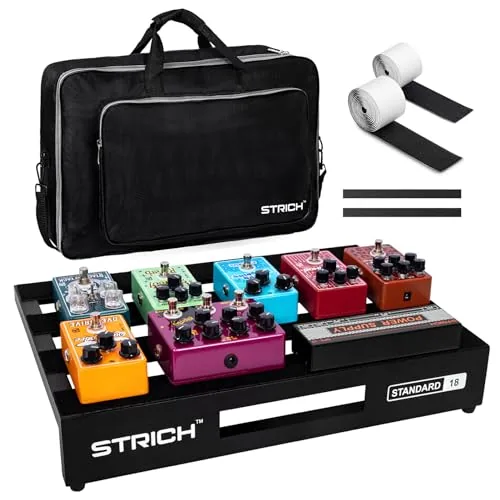
STRICH Guitar Pedal Board Aluminum Alloy 1.98lb Super Light Effect Pedalboard
Check price →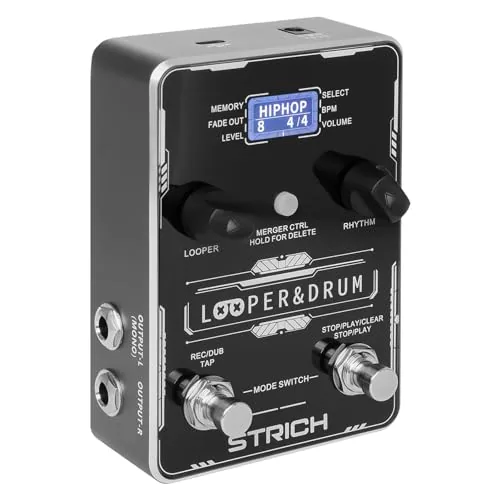
STRICH Circle Loop 2-in-1 Drum Machine & Stereo Looper Pedal for Guitar
Check price →A sample layout for six pedals
Here is one way to map a typical small rig onto the built-in outputs, based on the current each port lists. Check the label on your own pedals before wiring.
- Tuner on a 9V 100mA port.
- Compressor on a 9V 100mA port, or the 18V port if it is rated for 18V headroom.
- Overdrive on a 9V 100mA port.
- Fuzz or second drive on a 9V 100mA port.
- Digital delay on the 9V 300mA port.
- Reverb or looper on the 9V 700mA port.
That leaves one 9V 100mA port, the 12V port and USB free. A 12V preamp, a wireless receiver or a phone running a backing track can take those.
Using the included pedal cables and hook-and-loop strips, the layout should stay tidy without extra hardware. Cable routing on the larger boards is covered in the pedalboard guide.
Who should buy the STANDARD 15?
- Fly-rig players who want a few essentials and a quick setup.
- Beginners moving from loose pedals to a first board.
- Session players who need a phone charger at their feet.
- Loop players pairing a looper with a few drives; see our Circle Loop review.
It is less suited to players who swap pedals every month or plan a big rig. With seven 9V outputs and two higher-voltage ports, the supply is generous for six pedals, but the 15 x 11 inch deck runs out of room before the ports do.
If you already own a supply or plan to grow past six pedals, a separate SPS unit on a bigger board is the more flexible path. Our SPS-10 vs SPS-20 comparison covers that route, and the power supply guide ranks all three power options.
The STANDARD 15 is the board to pick when you want a small rig done in one purchase. The built-in supply has stronger 12V, 18V and high-current 9V ports than the brand's add-on units, plus USB charging. Choose it for four to six pedals; choose the STANDARD 18 or 22 with an SPS supply if your board will keep growing.
FAQ
Does the STRICH STANDARD 15 include a power adapter?
Yes. The listing includes a DC18V 2000mA adapter that feeds the built-in supply.
How many pedals fit on the STANDARD 15?
Four to six standard-size pedals on the 15 x 11 inch deck, depending on pedal width.
Can it power 12V and 18V pedals?
Yes. It has one 12V and one 18V output, each rated at 500mA.
What is the USB port for?
It supplies 5V at 800mA to charge a phone or similar device.
Are the outputs protected?
Each channel has independent short-circuit protection, per the listing.
Is the STANDARD 15 heavier than the STANDARD 18?
Slightly: 2.17 lb versus 1.98 lb, because the supply is built into the frame.